5 min
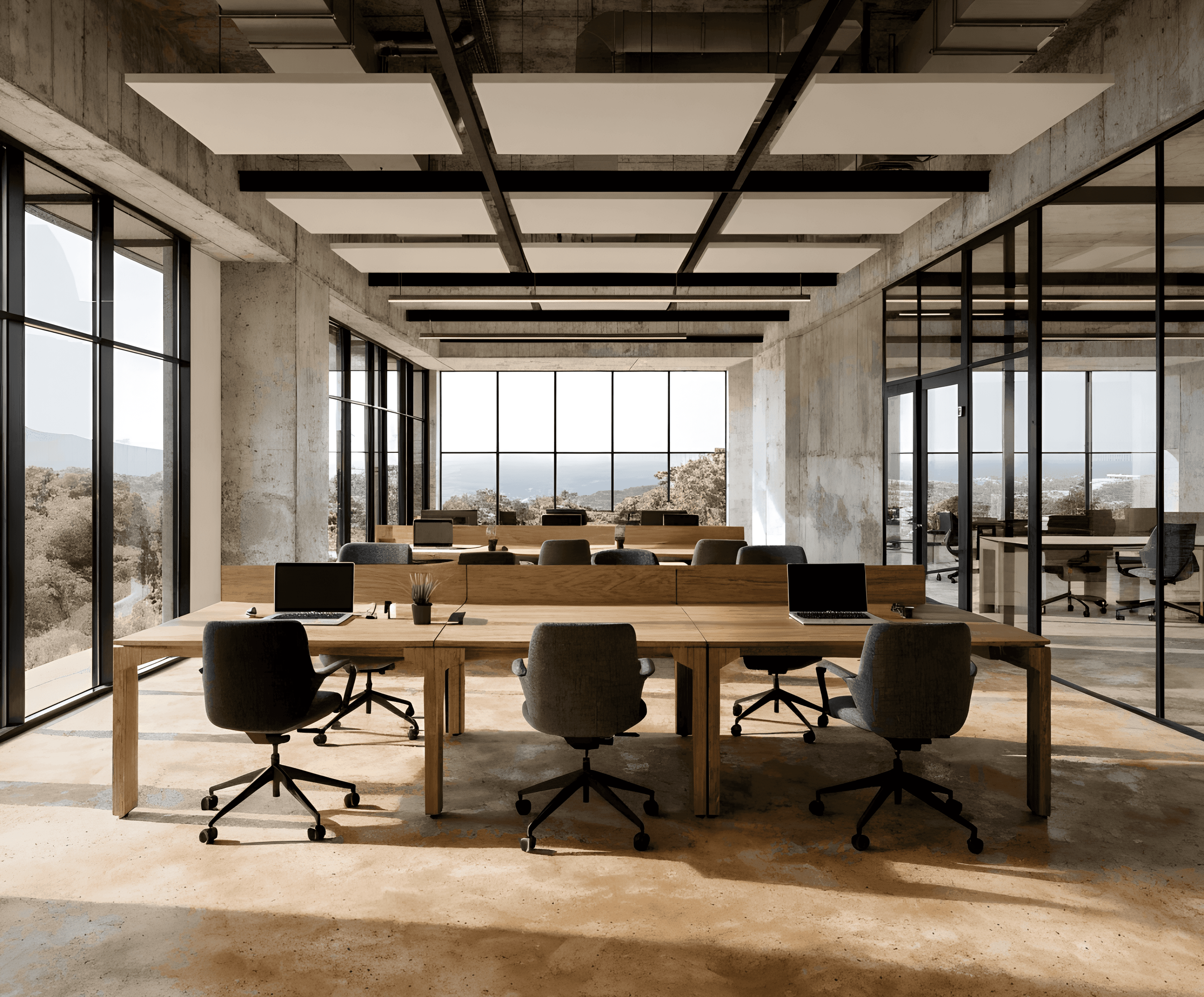
Standard meeting rooms routinely reach 1,400 ppm of CO2, a level linked to roughly a 50 percent drop in cognitive performance. The 3pm slump is often the room, not the workload. Ventilation, materials, and air quality decisions made at fit-out stage determine how clearly your team can think every afternoon.
The 3pm slump has a well-worn explanation: back-to-back meetings, a heavy lunch, the slow defeat of a long week. Managers address it with agendas, shorter sessions, standing desks. Some organisations have invested seriously in leadership training to keep energy up in the room. Very few have checked what the room itself is doing to the people inside it.
Standard practice has the wrong target
Offices make people worse at thinking. Not metaphorically — measurably, chemically, in ways that show up in test scores and decision quality within a single afternoon. The cause is not the workload or the calendar. It is the air, and in most workplaces it is being managed to a standard designed to prevent complaints, not to support performance. Those are not the same target. The gap between them, it turns out, is worth calculating.
Your team is not underperforming. The room is.
Picture a normal Tuesday. Three consecutive meetings in the same room, six to ten people per session, windows closed, ventilation running to code. By the time the third group sits down, the carbon dioxide concentration in that room is likely sitting somewhere between 1,000 and 1,400 parts per million. No broken equipment. No unusual conditions. A standard ventilated room with a standard number of people in it.
In 2015, researchers at the Harvard T.H. Chan School of Public Health measured cognitive performance across nine domains, including crisis response, strategic thinking, and information usage, while controlling CO2 levels in the test environment. At 945 parts per million, scores were 21% lower than in a well-ventilated space. At 1,400 parts per million, the gap reached 50%.
The more arresting finding is not the magnitude of the effect. It is the invisibility of it. People in high-CO2 environments do not feel impaired. They feel tired, mildly unfocused, quietly reluctant to wrestle with anything complex. The meeting gets the blame. The schedule gets the blame. The room goes unexamined. This applies whether a space is being designed from scratch or already occupied — retrofit ventilation upgrades, real-time monitoring, and low-emission material substitution are all available within an existing fit-out. The air quality question is not reserved for new buildings.
There is a second problem no one is specifying for
Carbon dioxide has the advantage of being measurable and well-documented. Volatile organic compounds (VOCs) are neither, which is part of why they rarely make it into a design brief. VOCs are emitted continuously by a wide range of standard commercial interior materials: furniture adhesives, flooring finishes, paint systems, cleaning products. They off-gas at higher concentrations immediately after installation and taper over months, depending on the material and the ventilation.
The United States Environmental Protection Agency has noted that indoor air can contain two to five times the pollutant concentration found outdoors. The Lawrence Berkeley National Laboratory has linked VOC exposure in ordinary office settings to headaches, airway irritation, and reduced concentration. A finish can be specified for its durability, its aesthetics, and its cost without anyone in the process asking what it emits, because that question has not historically been on the brief. For most of commercial construction history, the tools to answer it precisely did not exist. They do now.

The number that belongs in a board presentation
ASHRAE Standard 62.1 is the benchmark most commercial buildings are ventilated to. It was designed to keep CO2 below the threshold most occupants would find objectionable, and to manage odour. Cognitive performance was not the brief. This matters, because the two targets produce very different specifications.
The World Green Building Council's 2014 report "Health, Wellbeing and Productivity in Offices" found that increasing ventilation by just 11 litres per second per person above the minimum standard was associated with a 10% productivity improvement. Run the arithmetic for a fifty-person organisation at an average loaded cost of €60,000 per person and the result is approximately €300,000 of productive capacity, recovered through a decision made during fit-out rather than through restructuring or recruitment. That is the figure worth putting in front of a board.
The specification changes required to produce it are not experimental technologies. Setting ventilation targets above code minimum, selecting filtration capable of capturing fine particulates and chemical pollutants, building monitoring into the space so that air quality can be tracked against those targets over time — these are established practices. What is new is the precision with which their effects on human performance can be specified in advance.
What designing for air actually looks like
The Air concept within the WELL Building Standard, developed by the International WELL Building Institute (IWBI), does not tinker at the edges of current practice. It replaces the question. Rather than asking what level of air quality prevents complaint, it asks what level supports human health, sets measurable pollutant limits accordingly, and requires continuous monitoring to verify those limits are being met. Materials must meet low-emission criteria. Filtration must capture particulates down to 2.5 microns.
In practical terms, designing to it means one thing above all else: air quality targets must be set before materials are selected, not retrofitted around a fit-out that is already complete.
The τoπos perspective
We embed the Air concept from the first conversation, treating it as a performance specification rather than a certification ambition. Air quality targets are agreed before the material palette is assembled. Filtration and monitoring requirements go into the mechanical brief at the outset. Every finish is reviewed for its emissions profile as part of the specification process. This sits within the budget of a standard commercial fit-out. For you, it means the space your team works in was designed for the quality of thinking your organisation actually runs on.
The meeting that used to lose the room by hour two keeps its shape. Decisions get made rather than deferred. The afternoon stays useful. These are spatial outcomes, not just cultural ones. When air is specified to support performance rather than to satisfy code, the improvement arrives without announcement and compounds quietly over time. Living, designed well.